WeedSpin Australia Guide
WeedSpin Reviews and Complaints in Australia: How to Read the Evidence
 Available in US
Current WeedSpin reputation evidence needs to be read as evidence, not as a verdict. Trustpilot currently displays a guideline-breach warning for WeedSpin and says it removed fake reviews. Separately, Casino Guru records one unresolved complaint from an Australian player involving A$5,980. Those are meaningful reputation signals, but neither one proves that every positive or negative review is true, nor does one complaint establish a universal pattern of conduct.
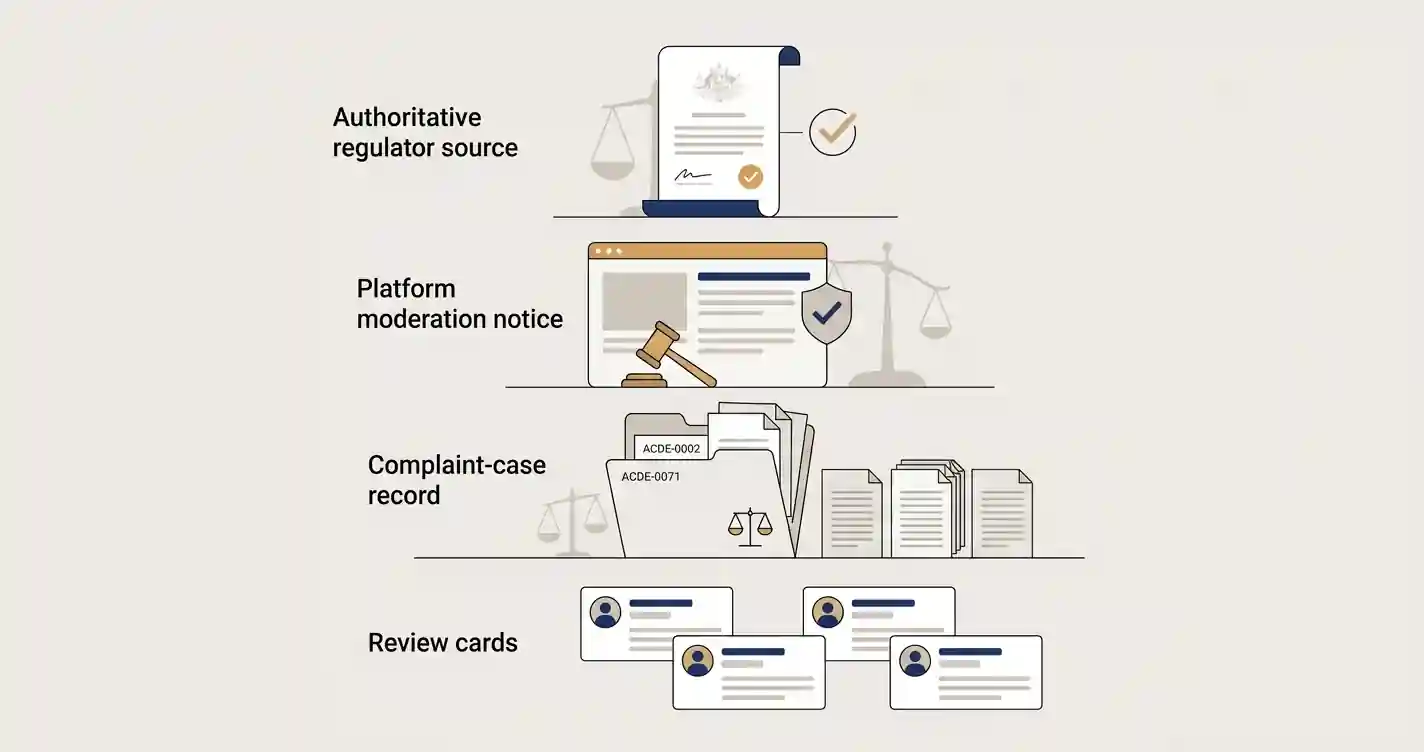
The useful question is therefore not “Is WeedSpin good or bad based on reviews?” It is “What kind of source is this, what does it actually document, and how much weight should it carry?” This page separates platform moderation, individual reviews, complaint-resolution records and regulator evidence so Australian readers can avoid turning ratings or allegations into stronger claims than the evidence supports.
For the broader brand overview, see the WeedSpin Australia review.
- The strongest current WeedSpin reputation signals
- Why the Trustpilot warning matters more than a star distribution
- What the Australian complaint record actually documents
- How to weight reviews, complaints and regulator evidence
- What positive and negative WeedSpin reviews can tell you
- Using Scamwatch guidance without mislabelling the brand
- A practical evidence checklist before trusting a review claim
- How much weight Australian readers should give WeedSpin reviews and complaints
The strongest current WeedSpin reputation signals
| Signal | Current documented position | Reasonable conclusion | Conclusion to avoid |
|---|---|---|---|
| Trustpilot moderation notice | Trustpilot displays a guideline-breach warning and says fake reviews were removed. | The platform itself has taken moderation action on the WeedSpin profile. | That every remaining review is false, or that the warning proves a specific casino offence. |
| Individual Trustpilot reviews | Current third-party evidence includes Australian reviewers describing personal experiences. | Australian-user activity around WeedSpin is evidenced. | That a positive review proves reliable payouts, or that a negative review proves misconduct in every case. |
| Casino Guru complaint record | One Australian complaint involving A$5,980 is marked unresolved. | A documented dispute exists and did not reach a resolved status through that complaint process. | That every allegation made by the player has been independently proven. |
| Australian regulator evidence | ACMA states that online casinos are banned services for providers to offer to people in Australia. | The Australian legal context is a regulator-level fact and carries more weight than review sentiment. | That a review score can substitute for a licence or legal-status check. |
Why the Trustpilot warning matters more than a star distribution
The important fact on the WeedSpin Trustpilot profile is not a point-in-time count of how many reviews sit in each star category. It is Trustpilot’s own moderation notice. The platform currently states that a number of fake reviews were removed. That is a direct statement about moderation activity on the profile, so it deserves more weight than simply averaging the visible opinions.
The warning has a limited scope. It does not establish that all remaining reviews are genuine or false, nor does it prove a particular payment outcome or legal status. Its proper use is narrower: treat the profile’s reputation data with extra care rather than as audited operational evidence.
Trustpilot also describes reviews as user-generated material that people can write about their experiences and can later edit or delete. That is another reason review totals, star distributions and individual comments should be treated as changeable records. Current profile status matters more than carrying forward a point-in-time review count or rating.
What the Australian complaint record actually documents
Casino Guru’s complaint record gives a more structured signal than a stand-alone review because it has a visible case status and chronology. The complaint was submitted on 8 April 2026 and was marked unresolved on 6 May 2026. It identifies the player as being from Australia and lists an amount of A$5,980.
Those details support a concise factual statement: Casino Guru records one unresolved WeedSpin complaint from an Australian player involving A$5,980. They do not justify repeating the player’s allegations as established facts about how WeedSpin operates generally. A complaint thread contains claims made by the parties and the complaint site’s own assessment. The existence, amount, dates and unresolved status are observable record facts; the disputed underlying conduct is a different evidentiary question.
This distinction is especially important for payout complaints. A single unresolved case is relevant when judging transparency and complaint handling, but it does not establish the casino’s normal withdrawal speed, limits, fees or approval criteria. Those operational questions belong in the separate guide to WeedSpin withdrawals, where unsupported exact payout conditions are deliberately omitted.
How to weight reviews, complaints and regulator evidence
- Start with regulator and primary legal evidence. For an Australian legal question, ACMA and legislation should outrank review-site sentiment. ACMA currently lists online casinos among the services providers are banned from offering to people in Australia.
- Then check platform-level moderation or case status. A Trustpilot warning or an unresolved complaint status is stronger than a user’s opinion because it records an action or classification made by the platform hosting the material.
- Use individual reviews as anecdotal experience reports. They can reveal themes worth checking, but they should not be converted directly into verified claims about payout speed, fairness, customer service quality or account rules.
- Look for corroboration across independent sources. Repeated themes become more useful when separate publishers document the same narrow fact, but agreement still does not turn an allegation into regulator evidence.
- Check recency. Review profiles, moderation notices and complaint statuses can change. A current source is more useful for a current reputation question than an undated image or an old affiliate summary.
The broader licence and trust evidence guide applies the same separation to licence, public terms, ownership and responsible-gambling information. It is useful to keep those structural trust signals distinct from reputation content because a positive review does not repair missing licence evidence, and a negative review does not create a regulator finding.
What positive and negative WeedSpin reviews can tell you
A positive review can tell you that one reviewer described a positive experience at a particular point in time. A negative review can tell you that one reviewer described a problem. Neither should be upgraded into a general statement without additional evidence. This matters most when reviews mention withdrawals, bonuses, account restrictions or customer support, because those topics often contain details that need terms, transaction records or direct operator evidence before they can be stated as general facts.
The same principle cuts both ways. Positive payout comments do not guarantee fast withdrawals, and negative payout comments do not prove every withdrawal will fail. Review evidence is best used as a lead for further verification.
For Australian readers, one further distinction matters. Current third-party material shows Australians using WeedSpin, but usage evidence does not equal Australian authorisation. The separate Australian legal context page explains ACMA’s provider-side rules and why local legal status should not be inferred from review activity.
Using Scamwatch guidance without mislabelling the brand
Scamwatch’s gambling and betting guidance is useful as a general checklist for Australians. It warns that illegal or fake gambling offers can use professional-looking branding, positive or fake reviews, bonuses or free spins, and repeated payment requests to look credible or extract more money. Scamwatch also advises people to verify whether a gambling service is legal before paying money.
That guidance should not be used to attach a scam label to WeedSpin. Scamwatch describes warning patterns that can appear in gambling scams generally; it does not make a WeedSpin-specific finding in the source used here. Its proper role is to help readers evaluate claims and payment requests without turning general guidance into a brand accusation.
Australian readers can review the current government guidance on the Scamwatch gambling and betting scams page. For the Australian provider-law framework, ACMA’s Interactive Gambling Act guidance is the more authoritative source.
A practical evidence checklist before trusting a review claim
Is the statement a platform action or a user’s opinion?
A moderation warning or complaint status is a documented platform action. A reviewer’s description remains an individual account.
Is the claim current?
Ratings, review volume, warnings and complaint status can change, so check the source close to the time you make a decision.
Does another independent source support the same narrow point?
Corroboration is more useful when it confirms the same fact rather than merely repeating the same allegation.
Would a primary source be better?
Legal status should be checked with a regulator. Exact contractual rules should be checked against current terms or other primary operator material when available.
Is the conclusion stronger than the evidence?
A single complaint can support “a complaint exists”. It cannot support “this always happens”. A positive review can support “a reviewer reported a positive experience”. It cannot guarantee future performance.
How much weight Australian readers should give WeedSpin reviews and complaints
The current reputation evidence is significant enough to justify caution in how WeedSpin reviews are interpreted. Trustpilot’s guideline-breach warning and removal of fake reviews is a platform-level moderation signal. Casino Guru’s unresolved Australian complaint involving A$5,980 is a documented dispute record. Neither should be ignored, but neither should be expanded beyond its actual scope.
The strongest reading is therefore evidence-weighted rather than score-based. Give regulator material the highest weight for Australian legal questions. Give platform moderation notices and complaint statuses more weight than individual testimonials. Treat positive and negative user reviews as anecdotal reports that can identify issues worth verifying, not as audited proof of normal casino performance.
That approach avoids both extremes: it does not use a handful of favourable comments to declare WeedSpin safe or trustworthy, and it does not use one unresolved complaint or a moderation warning to declare the brand fraudulent. It keeps the conclusion proportional to what is actually documented as of 11 September 2026.
Published by the Weedspin Casino team.