WeedSpin Australia Guide
WeedSpin Licence and Trust Signals in Australia: What the Evidence Shows
 Available in US
No Australian licence for WeedSpin was verified in the ACMA register on 11 September 2026. That register result is important, but it answers a specific question: whether WeedSpin appears as an Australian-licensed interactive wagering provider. It does not by itself prove every other claim about the brand, and it should not be converted into a blanket statement about what an individual player has or has not done under Australian law.
No foreign licence is presented as verified because the available sources do not provide strong enough primary support for a current validity claim. Casino Guru’s May 2026 review says it could not find public general Terms and Conditions and reports no responsible-gambling tools. Available ownership sources conflict, so no parent company is identified here. Reviews, moderation warnings and complaint records are considered separately from licence analysis.
For the broader product context, see the WeedSpin Australia review.
- The trust question has to be split into separate evidence categories
- Trust evidence table
- The Australian register result is narrow but important
- Why no foreign licence is presented as valid
- Public terms are a separate transparency test
- Ownership transparency cannot be repaired by guessing
- Responsible-gambling tooling is reported by one independent reviewer
- Brand age is context, not a verdict
- Reputation evidence belongs on a different page
- How to read trust claims without collapsing them into one label
- What WeedSpin’s licence and transparency signals mean for Australians
The trust question has to be split into separate evidence categories
Online casino review pages often compress many different questions into one label such as “legit”, “safe” or “trusted”. That shortcut loses important information. A regulator register answers whether a provider is locally licensed for the regulated activity covered by that register. Public terms show whether rules are available for inspection. Ownership disclosure can help identify who stands behind a service. Responsible-gambling tools show whether certain account controls are visible. Complaint and review records show how specific users or platforms describe their experience.
Those categories do not carry equal evidentiary weight, and none should silently substitute for another. An Australian register result comes from a regulator. A third-party review saying it could not find terms is useful but is not equivalent to an official terms archive. A user complaint can document that a dispute exists, but it cannot establish a universal operating rule. This page keeps those categories apart so the reader can see what each fact can actually support.
Trust evidence table
| Evidence category | Current finding | What it establishes | What it does not establish |
|---|---|---|---|
| Australian licence register | No WeedSpin entry was found in the current ACMA register. | No Australian licence for WeedSpin was verified in that register on 11 September 2026. | It does not by itself answer every consumer-law question or establish a separate foreign licence status. |
| Foreign licence | No foreign licence is verified by the available primary material. | The available sources do not support a current foreign-licence validity claim. | It does not prove that no foreign licence could ever exist. |
| Public general Terms and Conditions | Casino Guru’s May 2026 review says it could not find public general Terms and Conditions. | A current independent review recorded a transparency gap at the time of its assessment. | It is not proof that no terms can ever be supplied through an account or another channel. |
| Ownership or parent company | No owner or parent company is identified by the available sources with sufficient confidence. | The available sources conflict on ownership. | This must not be read as proof that no legal entity exists. |
| Responsible-gambling tools | Casino Guru’s current review reports no responsible-gambling tools. | One current independent reviewer did not identify those tools in its assessment. | It does not replace a direct inspection of every account screen or future product change. |
| Brand age | WeedSpin was established in 2025 according to current sources. | The available operating history is relatively short. | Age alone does not determine fairness, solvency, licensing or complaint handling. |
The Australian register result is narrow but important
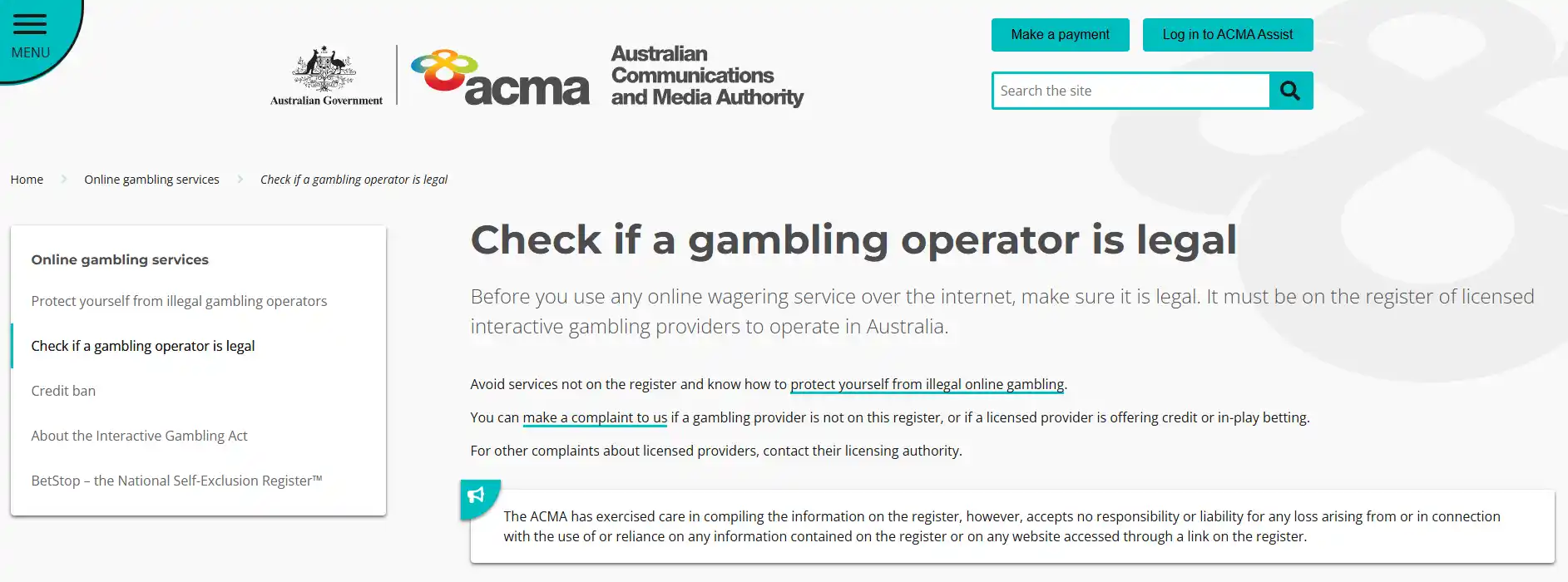
ACMA’s current “Check if a gambling operator is legal” page says an online wagering service must be on the register of licensed interactive gambling providers to operate legally in Australia. No WeedSpin entry was found in that register on 11 September 2026. The supported conclusion is that no Australian licence for WeedSpin was verified in the ACMA register on that date.
That sentence is intentionally narrower than “WeedSpin is unlicensed everywhere” or “WeedSpin is illegal for every Australian player”. The register is an Australian regulatory source with a defined scope. It is designed around licensed interactive wagering providers, while ACMA separately states that online casino services are among the services providers are banned from offering to people in Australia under the Interactive Gambling Act.
The statutory framework and the provider-versus-consumer distinction are explained in the child guide to Australian legal status. Keeping the register result separate from the broader legal explanation prevents a local-licence fact from becoming an overbroad legal conclusion.
The register itself can be checked on ACMA’s licensed provider page.
Why no foreign licence is presented as valid
Third-party material discusses purported overseas licences, but the evidence is disputed and is not strong enough to verify a foreign licence. A licence number, expiry date or specific validity claim needs direct primary or official-page support. That evidence threshold has not been met for a WeedSpin foreign licence.
A disputed third-party licence claim should not be treated as valid simply because it is convenient or repeated. Readers often treat a licence logo, jurisdiction name or review-site database field as if it were equivalent to a regulator register entry. It is not. A reliable licence claim should identify the licensing authority and be capable of being checked against an authoritative record.
Without current primary support, no Curaçao, PAGCOR, Gaming Curaçao or other foreign licence is presented here as valid.
Public terms are a separate transparency test
Casino Guru’s current review says it did not find public general Terms and Conditions for WeedSpin. That observation is useful because general terms are where a reader would normally expect to inspect account rules, restrictions, dispute provisions and other contractual conditions before relying on a service.
The finding should still be described accurately. It shows that an independent reviewer could not find public general terms during its assessment. It is not proof that no terms exist anywhere, and it does not justify importing rules from a competitor site or an affiliate summary. Unsupported exact wagering requirements, withdrawal limits and KYC document lists are therefore omitted.
The same separation applies to payment evidence. A payment method appearing in third-party data does not answer what the complete contractual withdrawal rules are.
Ownership transparency cannot be repaired by guessing
The available sources do not support a clear public parent-company claim. One source describes the owner as undisclosed, while lower-reliability material uses branding or network language that does not identify a verified legal entity. Because those sources conflict, no company is identified here as WeedSpin’s parent.
Missing ownership information is not a reason to infer a parent company from a domain registration, a marketing phrase or another casino with similar branding. Readers can treat the absence of a verified ownership statement as a reason to seek clearer disclosure, without turning that absence into an allegation.
Responsible-gambling tooling is reported by one independent reviewer
Casino Guru’s current WeedSpin review reports no responsible-gambling tools. This is treated as a partially verified, attributed fact because one independent reviewer supports it. It is not written as a regulator finding and it is not expanded into a claim about every current account screen.
For Australian readers, it is also important not to assume that BetStop fills this gap. BetStop covers Australian-licensed online and phone wagering providers and does not apply to online casino games or other gambling services illegally provided in Australia. The broader legal guide explains that distinction in context.
If gambling is becoming difficult to control, ACMA’s current guidance points to Gambling Help Online and the National Gambling Helpline. Those are Australian support resources, not WeedSpin features.
Brand age is context, not a verdict
The current evidence records WeedSpin as established in 2025. A relatively short operating history can limit the amount of long-term evidence available, but the founding year does not by itself tell a reader whether payments will be handled well, whether a complaint will be resolved, or whether a licence claim is valid.
That is why this trust page does not use age as a shortcut for credibility. Structural checks are more useful when they stay specific: regulator status, verifiable licensing, accessible terms, identifiable ownership, account protections, payment evidence and complaint handling each answer different questions.
Reputation evidence belongs on a different page
Trustpilot moderation signals and the Casino Guru complaint record are relevant to a full evaluation, but they are reputation evidence rather than licence evidence. Mixing them into the licence section would make it too easy to suggest that a negative review proves a regulatory breach, or that a positive review proves regulatory approval.
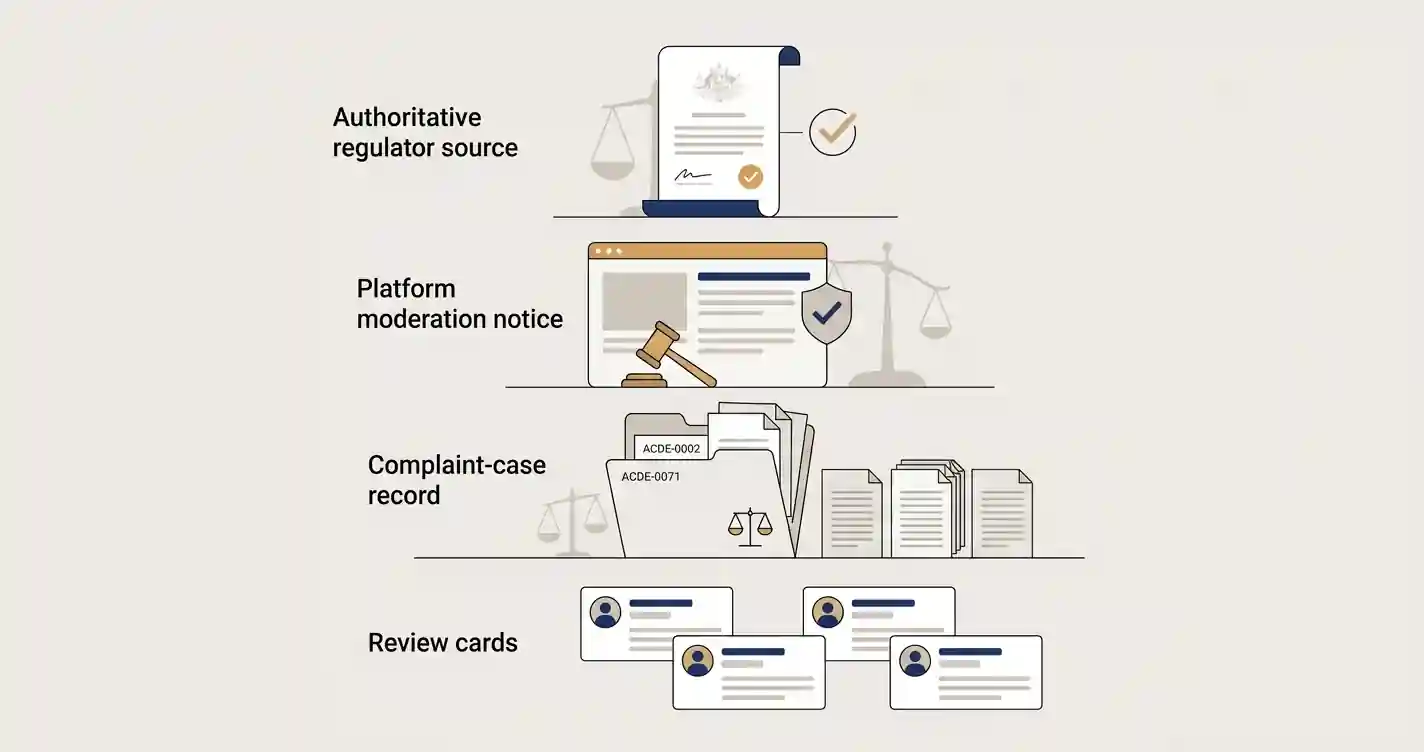
The dedicated WeedSpin reviews and complaints page handles those records with their own evidence boundaries. It distinguishes platform moderation, user opinion and a documented unresolved complaint from claims about universal payout behaviour or criminal conduct.
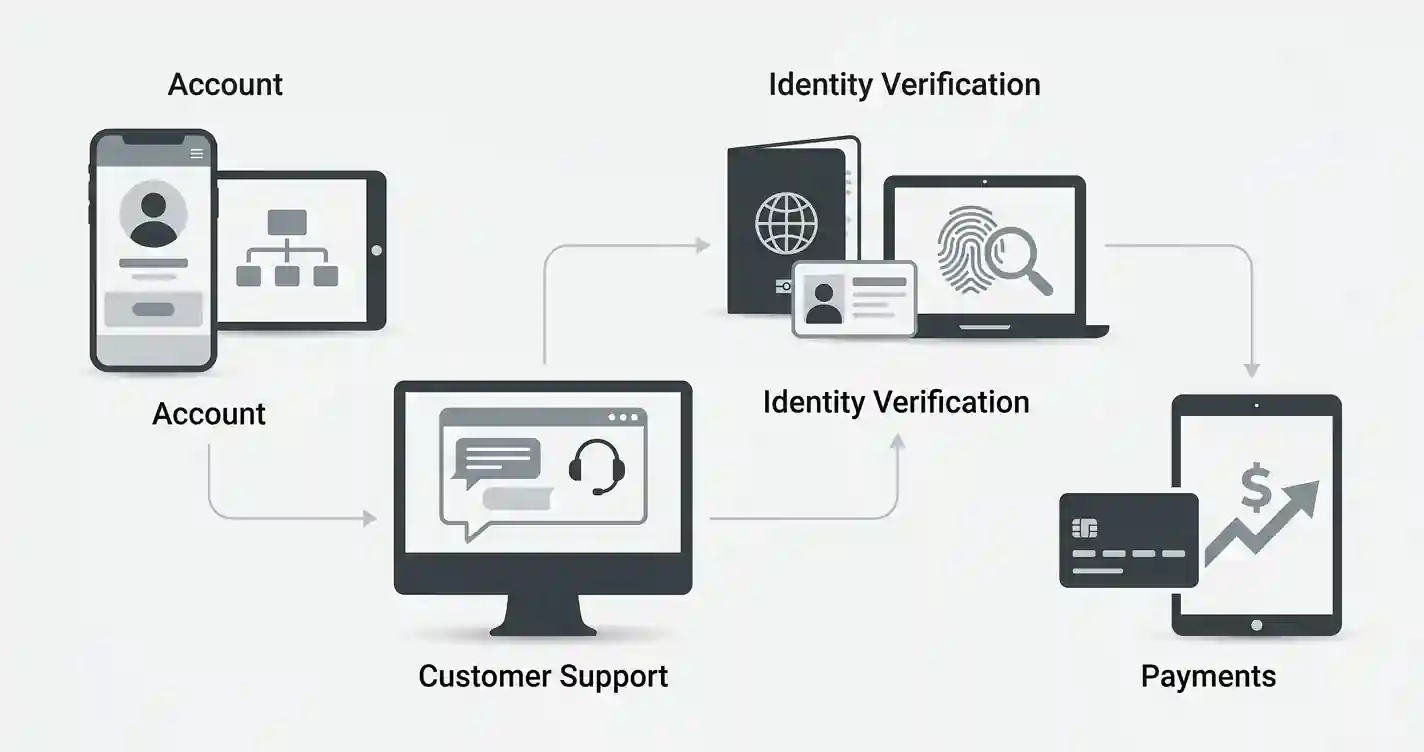
For the account and support side of the evidence, see registration and support.
How to read trust claims without collapsing them into one label
- Ask what authority produced the evidence. A regulator register has a different role from a review site’s database.
- Check the exact scope. An Australian wagering register is not a global licence registry and does not license prohibited casino-style services.
- Separate absence of evidence from evidence of absence. If ownership cannot be verified, do not invent an owner and do not claim that no owner exists.
- Keep user disputes in context. A complaint can be real and unresolved without proving a universal rule about every account.
- Do not use marketing presentation as compliance evidence. Australian language, AUD payments or a polished interface do not establish an Australian licence.
This method is slower than giving a single score, but it is more useful because it shows which conclusions are supported and which remain outside the evidence.
What WeedSpin’s licence and transparency signals mean for Australians
The strongest current structural fact is the Australian register check: no WeedSpin Australian licence was verified in ACMA’s register on 11 September 2026. A valid foreign licence cannot be stated from the available evidence because it does not meet the required threshold. Casino Guru’s May 2026 review says it could not find public general Terms and Conditions and reports no responsible-gambling tools. Ownership is not named because the available sources do not support a reconciled public ownership fact.
Those findings are meaningful, but they should remain separate. The licence result is a regulatory-status fact. The terms and responsible-gambling observations are third-party transparency findings. Ownership is an unresolved evidence gap. Reviews and complaints are handled separately. For a reader deciding what weight to give any claim, the best approach is to identify the category first and then ask whether the source is authoritative for that category.
For the Australian statutory framework, continue to ACMA and WeedSpin legal status. For product-side evidence, use the payments guide rather than assuming that a trust label answers transaction questions.
Written by the editors at Weedspin Casino.