
Real-Money Casino Table Games in Australia
 Available in AU
Compare live-dealer and software-run formats, and see what the available information can establish about odds and outcomes.
- What Counts as an Online Table Game
- Australia’s Legal Boundary for Real-Money Online Play
- Table-Game Formats and the Bitcoin Question
- What the Available Facts Can—and Cannot—Say About Odds
- How Table-Game Decisions and Outcomes Work
- Finding Table Games Near You: What This Evidence Can Establish
- Table-Game Categories Without an Unsupported Catalogue
- Card-Based Play: Betting on a Hand, a Banker, or a Tie
- Roulette Layouts and the Difference Between Zero and Double Zero
- Poker’s Objective: Building the Strongest Hand
What Counts as an Online Table Game
A casino table game is a game presented around a table-based format, with play organised through a dealer or a software-run version of the game. Online, the screen is the point of access, but the process behind the result can differ substantially. The key distinction is whether a live dealer and physical equipment are being streamed, or whether software determines the result.
In a live-dealer game, a real dealer operates real casino equipment while video of the session is streamed to players. The screen shows the physical activity as it happens. The game is therefore not simply a digital animation of a table: its visible dealer and equipment are part of a live video stream.
A software-determined table game works differently. Its result is generated by a Random Number Generator, or RNG. In an online card game, the RNG determines which cards are dealt; in online roulette, it determines where the ball lands. The interface may present a table and familiar game elements, but the outcome comes from the software rather than from a streamed physical session.
For real-money table games in Australia, check that a casino’s games and payment options suit you before depositing. The details below highlight the specific operator information available for each listing.
License: Curacao Gaming Control Board JustCasino is listed with a Curacao Gaming Control Board license.
License: Curacao, operated by Dama N.V. 7Bit Casino is licensed in Curacao and operated by Dama N.V.
License: Curacao (operating since 2017) · Min. deposit: A$20 Uptown Pokies has operated since 2017 and is licensed in Curacao. Its minimum deposit is A$20.
License: Curacao · Min. deposit: A$20 (POLi) Lucky Dreams is licensed in Curacao, with a A$20 minimum deposit via POLi.
License: Curacao eGaming OGL/2023/174/0082 (Dama N.V.) · Min. deposit: A$15 LevelUp Casino is licensed under Curacao eGaming OGL/2023/174/0082 and operated by Dama N.V. Its minimum deposit is A$15.
License: Curacao eGaming OGL/2024/923/0383 (Antillephone N.V.) · Min. deposit: A$30 WinSpirit Casino is licensed under Curacao eGaming OGL/2024/923/0383, issued to Antillephone N.V. Its minimum deposit is A$30.
Payout speed: crypto ~90 minutes, fiat 1-5 days · Min. deposit: A$30 Kingmaker lists a A$30 minimum deposit. Its stated payout speed is around 90 minutes for crypto and 1–5 days for fiat.
License: Curacao Gaming Control Board OGL/2023/176/0095 (Hollycorn N.V.) Rollero Casino is listed with Curacao Gaming Control Board license OGL/2023/176/0095, held by Hollycorn N.V.
License: Curacao Gaming Control Board OGL/2023/176/0095 (Hollycorn N.V.) GoldenCrown is listed with Curacao Gaming Control Board license OGL/2023/176/0095, held by Hollycorn N.V.
License: Curacao Golden Pokies is listed as licensed in Curacao.
That difference matters when describing what an online table game is. “Table game” identifies the broad style of play, not a single technical format. A live-dealer version depends on a real dealer, physical equipment and a live stream. A software version uses an RNG to determine the result. The two may both appear on a screen as table games, while the process producing the outcome is not the same.
This also clarifies why an online table should not be treated as a literal casino table transferred intact to a device. In one format, the player sees a live session involving real equipment. In the other, a software system determines the relevant result and presents the game digitally. The shared label describes the game format; it does not establish that the underlying process is shared.
For an online casino table game, the useful first question is therefore not how realistic the screen looks. It is whether the game is streamed from a real dealer and equipment or whether an RNG determines the outcome. Visual presentation alone does not answer that. A polished digital table can still be software-run, while a live-dealer game is identified by the streamed dealer and physical equipment.
The distinction is straightforward but consequential for classification. Live-dealer play is a streamed, real-world session. Software-determined play is an online game whose outcome is generated by an RNG. Both fall under the broad idea of table games at a casino, but “online table game” does not, by itself, tell which format is in use.

Australia’s Legal Boundary for Real-Money Online Play
Australia’s Interactive Gambling Act 2001 sets the central boundary for online casino services. Under Section 5, a business operating from within Australia cannot offer residents interactive casino games for real money. That prohibition covers online table games as part of the wider category of casino gambling; it is not a special rule for one type of game or one payment method.
The practical distinction is between the activity and the wording used to describe it. Calling a service an online casino, a table-games site, or a place to play live casino games does not change the legal position if it provides real-money casino gambling to people in Australia. Nor does a promotion alter the underlying service. A bonus attached to a prohibited offering does not create a separate lawful category.
The Act is not a domestic licensing route for real-money online casinos. Australian companies are barred from supplying those services to residents, rather than being able to make the same offering lawful by obtaining a local casino licence. The framework therefore differs from markets where an operator can apply for a local online-casino permit and then offer table games under it.
Enforcement and the effect on availability
The Australian Communications and Media Authority (ACMA) is responsible for enforcing the relevant restrictions. Its role includes blocking unlicensed domestic platforms. The purpose of that intervention is to limit access to services that breach the law, not to certify an alternative group of casino sites as approved for Australian customers.
Legal Prohibition
Under the Interactive Gambling Act 2001, businesses operating within Australia cannot offer residents interactive casino games for real money.
The legal assessment concerns the service being supplied to people in Australia. A website’s overseas location or foreign authorisation does not, by itself, make the offer lawful under Australia’s rules. The Act’s restriction on providing real-money interactive casino gambling to people in the country remains the key point. It would therefore be inaccurate to treat offshore availability as proof that a service is permitted, or to present a foreign licence as an Australian online-casino licence.
These restrictions concern the provision and promotion of services, not a stated criminal penalty for an individual simply for being a customer. The legal framework described here places the prohibition on operators supplying the service. That distinction should not be mistaken for an endorsement of offshore play: an individual’s lack of the same operator-facing prohibition does not turn the service into a lawful Australian offering or remove the access controls applied by ACMA.
Advertising is also constrained. A description that encourages Australians to use a real-money online casino, or promotes a deal for table games, would cross into promoting the very service the law restricts. A purportedly informational label does not change the substance if the content directs people towards an operator or inducement. For the same reason, claims about the best online casino promotions for table games do not sit outside the legal boundary merely because the offer is framed as a comparison.

What the rule means for different kinds of offers
The restriction applies to real-money interactive casino gambling, including table games, rather than only to one delivery format. Whether play is presented through streamed video or software does not create an exception to the operator’s obligation. The legal question is not whether the experience resembles a physical casino; it is whether a service is being supplied for real-money casino play to people in Australia.
A reference to free table games needs a separate reading from a real-money offer. The rule described here concerns real-money services, so the phrase “free” alone does not establish what a particular product does or whether it leads into paid gambling. It is not a basis for assuming that every free-play page is lawful, nor for treating a promotional free-play offer as permission to access real-money games. The terms and function of the actual service matter.
The boundary is therefore straightforward, even if websites use varied labels: Australian-based operators cannot provide real-money online casino table games to residents, and ACMA enforces the restrictions. A foreign location, a bonus, or a different presentation does not provide a domestic authorisation. No local licence route for these services is established by the Act’s framework.
Table-Game Formats and the Bitcoin Question
Bitcoin and a table game describe different parts of an online gambling transaction. Bitcoin is a payment method; it does not, by itself, describe how a game is run. The game format concerns how cards, dice or a roulette result are produced and presented. Treating those as one feature makes comparisons less useful: a payment method is not a game rule.
Bitcoin is a payment method and does not describe how a game is run or determine the game’s rules and outcomes.
In software-based online play, a Random Number Generator determines outcomes such as the cards dealt or where a roulette ball lands. The result is generated by software rather than by a physical table operating in the player’s presence. The payment method does not change that basic distinction. A reference to bitcoin alone therefore says nothing about how a particular hand or spin is determined.
Live-dealer play uses a different presentation. A real dealer and casino equipment are filmed, with the video streamed to players. That describes the source and display of the game action; it does not establish which payment methods are accepted, or whether any particular service is available to people in Australia. “Live” refers to the streamed dealing, not to a different meaning of bitcoin.
This distinction also matters when someone compares bitcoin table games with games associated with conventional payment methods. The useful comparison is between the game formats and their rules, not between payment labels. If two online games use software to determine cards or a roulette landing position, the fact that one is described alongside bitcoin does not establish a different outcome mechanism. If play is streamed from a live dealer, the stream describes how the action is presented; it still does not make the payment method a rule of the game.
The label “bitcoin casino” can consequently be narrower than it sounds. It identifies a payment association, not a distinct category of table game. It does not establish that a site offers a particular table, that a game has different rules, or that its results are generated in a different way. Those details are separate questions and should not be inferred from the currency label.
Nor does the label settle whether a table is operating at a given moment. Availability is a service condition, while bitcoin is a payment designation and the game format is a matter of how play is conducted. Combining them in a single phrase does not prove that a specific game is open, suitable for a particular player, or accessible in Australia.

For Australian readers, the legal setting remains separate from this technical distinction. The Interactive Gambling Act 2001 prohibits operators from providing real-money online casino games to people in Australia. A payment method does not alter that boundary. Describing a service as bitcoin-based does not turn a prohibited real-money casino game into a different legal category.
A sound comparison therefore keeps three questions apart: how the game’s outcome is produced, how the action is presented, and what payment method is associated with the service. Bitcoin answers only the last of those. The game format determines whether outcomes come from software or whether a real dealer and equipment are streamed; neither description, on its own, establishes a change in rules or results because bitcoin is involved.
What the Available Facts Can—and Cannot—Say About Odds
There is no defensible way to name the table game with the best odds, or the worst, without comparable figures for the relevant bets. A ranking needs more than game names: it needs the probability attached to each possible result and the payout offered for that result. Without both, a claim about which option returns more is incomplete.
“Odds” can refer to different things. It may mean the chance of a particular outcome, the payout attached to a winning bet, or the overall mathematical edge built into the terms. These measures are related, but they are not interchangeable. A wager can appear attractive because it pays more when it wins, while still being less favourable once the chance of winning is taken into account. A payout alone does not settle the comparison.
A house-edge chart is useful only when its entries are calculated on a consistent basis. Each figure needs to identify the exact wager and the rules under which it is offered. If one entry describes one bet and another describes a different bet, placing them side by side can create a ranking that looks precise but answers no consistent question. The label “best odds” does not remove those differences.

The same issue applies when comparing games as whole categories. A game may contain several possible bets, and a single figure cannot automatically describe every choice within it. A game-level ranking would therefore need to explain which bet the figure represents. Otherwise, “best table game” is too broad to carry a reliable mathematical meaning.
That does not show that all games have equal odds.
For a meaningful comparison, the terms would need to be specific enough to connect a wager, its possible outcomes and its payouts. The calculation would also need a clear reference point: for instance, whether the comparison concerns one particular bet or the game’s overall structure. Without that detail, a percentage or rank would give the appearance of measurement without showing what was measured.
The practical distinction is between a description of play and a calculation of expected return. Knowing that a table game exists, or understanding its broad objective, does not by itself establish the chance of a result or the value of a payout. Those are separate questions, and the numerical terms are what answer them. Until comparable figures are available, the most accurate conclusion is limited: no particular table game can be identified as having the best casino odds, and none can be labelled the worst on this basis.
How Table-Game Decisions and Outcomes Work
A table game can be understood by identifying what is being compared or predicted, then separating that condition from the result of the round. In Blackjack, the relevant comparison is between the player’s hand and the dealer’s: the aim is to finish with a hand value closer to 21. In a dice game, the wager is tied to the outcome of rolling a pair of dice. These are different structures. One compares two hands against a target; the other connects a bet to a dice result.

That distinction helps explain how to approach the rules without treating every table game as if it followed the same decision process. A hand-based game centres on the values being compared. A dice-based game centres on the result specified by the wager. In either case, the terms of the particular game determine what counts as a successful outcome. The general objective alone does not establish how a specific bet is settled.
A hand compared with the dealer
Blackjack’s central objective is relative: the player is competing against the dealer for the hand closer to 21. The number matters because it is the reference point, while the dealer’s hand matters because the comparison is between opponents. Reaching a particular value cannot be considered in isolation from the game’s stated conditions.
For someone learning how to play table games at a casino, this is the useful starting point: identify the hand being evaluated, the target it is measured against and whose hand provides the comparison. Those elements describe the objective without assuming additional rules about what actions are available or how every possible result is handled. Details beyond the objective must come from the rules attached to the specific game.
This also separates understanding a game from predicting its result. Knowing that the aim is to be closer to 21 explains what the contest is about; it does not determine which hand will finish closer. The objective is a rule for judging the outcome, not a forecast.
A wager connected to dice
In a dice table game, players roll a pair of dice and bet on the outcome. The structure therefore begins with a prediction about a result produced by the roll. To understand a wager, the important question is what outcome that bet refers to. The roll supplies the result; the bet sets the condition against which that result is judged.

This is not the same decision structure as comparing a hand with a dealer’s hand. The dice wager does not depend on a player’s hand being closer to a target. It depends on the relationship between the roll and the outcome covered by the bet. The exact settlement cannot be inferred merely from knowing that a pair of dice is rolled; it depends on the rules attached to the wager.
A clear reading of either game begins with the same accounting discipline: distinguish the objective from the result, and the result from the settlement of a bet. Blackjack supplies a comparison against the dealer, measured against 21. The dice game supplies a roll and a wager on its outcome. That is enough to describe their basic mechanics without turning a simple objective into a promise about results.
Finding Table Games Near You: What This Evidence Can Establish
A search for a casino nearby is a request for a location-specific answer: which venue is close, whether it is open, and whether it has table games.
The distinction matters because proximity and availability are separate claims. A venue may appear relevant to a location-based search without its distance from a particular address being known. Even a confirmed venue would not, by its existence alone, establish that table games are available there. Treating either point as settled would turn a general description into an unsupported local recommendation.
Searches that name places such as Miami or Ohio refer to locations outside Australia. They do not answer which casino, if any, is near an Australian reader, nor do they verify what games a venue in another jurisdiction offers. Location terms are not interchangeable: a result for one city cannot establish availability in another.
The same caution applies to references to a new casino or newly added table games. “New” depends on a dated, venue-specific announcement or listing. Without that, it cannot establish when a venue opened, whether a game was recently introduced, or whether the offering remains current. A game category described generally is not confirmation that a local venue provides it.
A reliable local comparison would need to connect a named venue to a defined location and to current information about its table-game offering. Without those particulars, there is no defensible basis for naming the nearest casino, ranking nearby venues, or promising that a particular game can be found at one. Distance, opening status and available games are separate details, and none should be inferred from a broad location phrase alone.

This also means that a request for a casino close by cannot be answered by substituting a list of game mechanics or categories. Those describe how games are structured; they do not establish where they can be played. Nor does a general reference to casino table games amount to confirmation of a physical venue’s current facilities.
A venue name, distance, opening detail or game list would require current information tied to that place. Until those details are established, the accurate answer is limited to the subject of the search, not a claim about what is available nearby.
Table-Game Categories Without an Unsupported Catalogue
A useful way to organise casino table games is by the material that structures the contest. The categories established by familiar examples are card-hand games and dice-based games. These labels describe different forms of play; they do not imply that every casino offers the same selection.
Card-hand games
Blackjack and poker sit within the card-game category, but they are not the same kind of contest. In blackjack, the player’s hand is assessed against the dealer’s, with the aim of finishing closer to 21. Poker centres on forming the strongest possible hand. The first description is about a comparison with the dealer; the second is about the strength of a hand.
That distinction matters when sorting a casino table-games list. A shared use of cards does not make the games interchangeable. Blackjack is identified by the target value and dealer comparison, while poker is identified by the objective of building a strong hand. These are broad category markers, not a catalogue of every card game or variation.
Dice-based games
Dice-based play forms a separate category. In the example described by this format, players roll a pair of dice and place bets on the result. The defining feature is therefore the dice outcome, rather than the value or ranking of a card hand.
This gives a straightforward distinction between the card and dice categories: one is organised around hands, while the other is organised around a roll. The difference is structural, not a statement about which kind is more favourable or more enjoyable. No ranking follows from the category alone.
Organised around hands, such as blackjack and poker, where objectives involve comparing values or building the strongest hand.
Organised around a roll, where players roll a pair of dice and place bets on the resulting outcome.
Reading a table-game list
A casino table-game list can be easier to interpret when its entries are grouped by structure rather than presented as an undifferentiated string of names. Blackjack and poker belong under card-hand games; dice wagering belongs under dice-based games. This arrangement identifies the form of the contest without implying that the examples exhaust the category.
The same care applies to phrases such as “best table games.” A category label can clarify what a game involves, but it does not establish a best choice. Blackjack, poker and dice-based play have different objectives and decision structures, so a preference cannot be inferred from their names alone.
“Casino table games” is a broad label, not a guarantee that a particular venue or service carries every category. A list should be read as a description of the games it actually names. Grouping the examples by cards or dice keeps the distinctions clear without turning a short set of recognised types into a supposedly complete catalogue.
Card-Based Play: Betting on a Hand, a Banker, or a Tie
One card-game betting structure presents three possible selections: the Player’s hand, the Banker’s hand, or a tie. The wager is placed on which of those outcomes will apply. This gives the table a clear accounting framework: each bet belongs to a named outcome, rather than to an unspecified interest in the game.
The labels describe the available betting positions. A Player bet selects the Player’s hand; a Banker bet selects the Banker’s hand; a tie bet selects the tied outcome. The distinction matters because these are separate choices, not different names for the same wager. A selection records the outcome being backed, while the result determines whether that selection matches.
This is a compact format for card-table play. Instead of requiring a wager on an individual card, the structure groups the decision around the outcome represented by one of three labels. That is the relevant feature when comparing card-based casino table games: the betting options are defined by the hand or tie, not simply by the fact that cards are used.

The words “Player” and “Banker” identify the two named hands in this betting structure. They should be read as labels for the available outcomes, not as a measure of which position is more favourable. Likewise, “tie” is its own selection. The names alone do not establish how a particular wager is settled, what it pays, or whether the treatment of one selection changes when another outcome occurs. Those details depend on the rules attached to the specific game.
For a practical comparison, the useful distinction is therefore narrow but concrete: a card table may allow a wager on the Player’s hand, the Banker’s hand, or a tie. The selected position is the basis of the bet. Any further calculation requires the table’s stated rules and terms; the three labels, by themselves, do not supply a payout schedule or a basis for ranking the choices.
Roulette Layouts and the Difference Between Zero and Double Zero
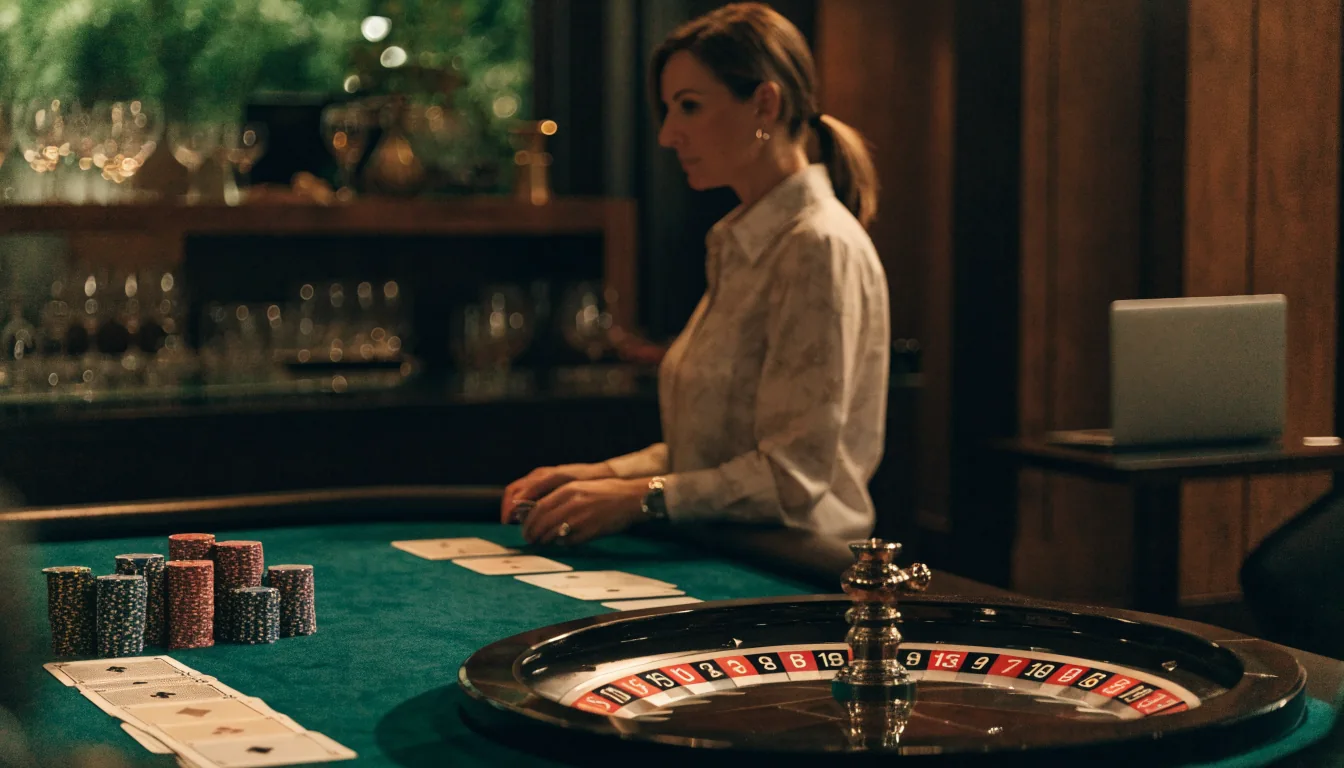
Roulette is offered in several layouts, with European, French and American versions among the main types. The most visible distinction is the arrangement of the green zero pocket: European and French layouts have a single green 0, while the American layout has both 0 and 00. That difference is part of the table design, not a cosmetic label.
European and French roulette share the stated count of 36 numbered positions and one green zero. The American version adds a green double-zero position alongside its zero. On a displayed layout, the labels make the distinction clear: a single 0 identifies the European or French arrangement described here; 0 and 00 identify the American one.
This is a narrow comparison of layouts. It does not establish a ranking, a house edge, or which version offers better odds. Those claims require information beyond the pocket labels and number count. Treating the extra green marking as a complete account of the rules would be an accounting error: the layout identifies a structural difference, not every condition governing a wager.
The same distinction matters when reading descriptions of roulette as one of the casino table games. A title or image may indicate a version, but it does not by itself confirm how a particular game is operated, what rules apply, or whether it is lawfully available in Australia. The layout can be described without implying that real-money online play is permitted.
Nor does a roulette layout say whether a game is free to access, available for hire, or attached to a promotion. Those are separate matters, and the presence of a single zero or double zero supplies no terms for them. A promotion label cannot be inferred from the wheel, just as the wheel cannot establish the conditions of an offer.
For a basic comparison, the useful check is therefore limited and concrete: European and French roulette have 36 numbers and a green 0; American roulette has a green 0 and 00. Beyond that, claims about rules, access or financial outcomes need their own evidence.
Poker’s Objective: Building the Strongest Hand
Poker centres on a contest to build the strongest possible hand. That objective separates it from a game whose outcome is based on a dice result or a ball landing on a wheel: the focus here is the hand assembled by each player.
In casino poker, the central question is not simply whether a player has received cards, but how strong the resulting hand is in relation to the contest. Players compete to produce the best hand they can. The precise details of play can differ between poker formats, so the broad objective should not be mistaken for a complete description of every table’s rules.
That distinction matters when considering casino poker table games as a category. The shared feature is the effort to form a strong poker hand; the label alone does not establish which version is being played or how its individual rules work. A game name, table description or promotional label cannot substitute for the rules that define a particular format.
The objective also gives a useful boundary to the term “poker.” It describes hand-building competition, not every card game offered at a casino table. Betting on a player’s hand, a Banker’s hand or a tie belongs to a different card-game structure and should not be treated as poker merely because cards are involved.
For anyone comparing types of casino poker games, the sound starting point is therefore modest: identify the format and its rules, then understand how that format defines a strong hand. Without those details, claims about how a particular poker table works would go beyond the basic objective. Poker’s core remains straightforward; the mechanics that shape each version are a separate matter.
Can you play table games online for real money?
Offshore services may be available to Australian players, but that availability does not make them lawful Australian offerings. Australian operators are prohibited from providing residents with real-money online casino games.
What is the legal status of online table games for Australian players in 2026?
Australian operators are prohibited from offering residents real-money online casino games, including table games. An offshore website or foreign authorisation does not by itself make the service lawful under Australian rules.
Are online casinos legal in Australia?
Australian-based operators cannot legally offer residents real-money online casino games. Offshore availability or a foreign licence does not make a casino an Australian-licensed service.
Created by the ”Weedspin Casino” editorial team.